
Your Hydrangeas In September
Your Hydrangeas In September
Caring for Cape Cod’s Signature Plant in the Fall
September and October is a beautiful time to be in gardens on Cape Cod. The air is usually cooler, and there are many plants still in bloom. Some of the shrubs that can be most beautiful at this time of year are the Hydrangeas, and this blog addresses what you can and can’t do for these plants for your enjoyment now and into the future.
Keep Your Blue Big-Leaf Hydrangeas Watered
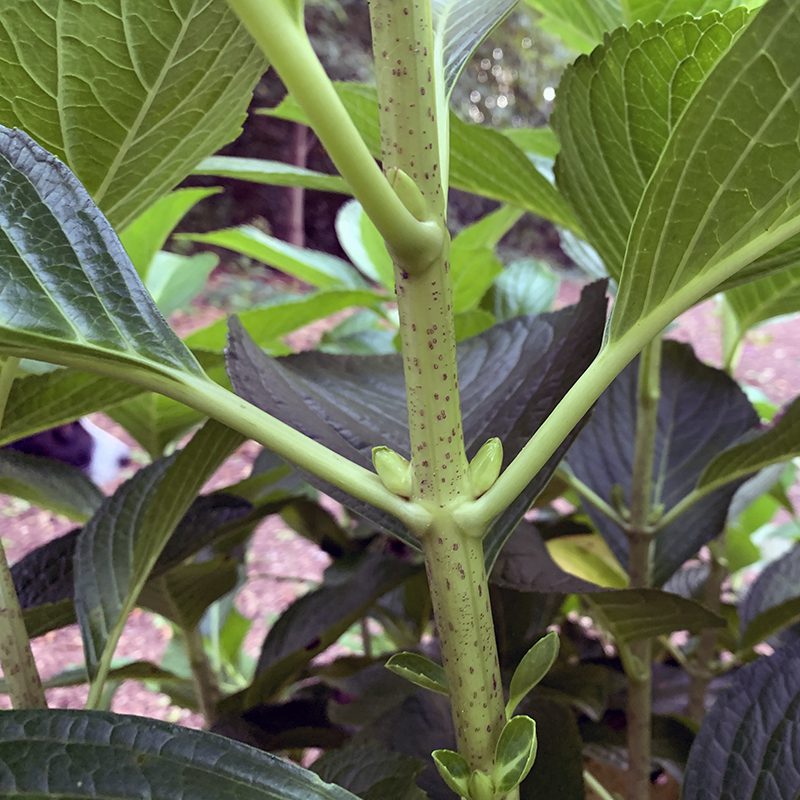
Right now your Hydrangea macrophylla (aka big-leaf or mophead) and your Hydrangea serrata (aka mountain hydrangeas, often lacecaps), have the germ of next year’s flower on their stems. You can see it where the leaf attaches to the stem – see photo below – and flowering for next year depends on that bud staying healthy though the fall and winter. Since our soils are quite dry, any of these Hydrangeas that haven’t been watered are in danger of having those buds dry up. Since the nights are cooler now you no longer have to water these shrubs more than once a week, but a deep soaking that’s equivalent to an inch of rain measured in a rain gauge will keep those buds in good shape going into the winter.
Don’t Fight Your Hydrangea’s Size
It’s impossible to keep a Hydrangea small if it has genetics that tell it to grow tall. Pruning always stimulates growth. For more information about pruning Hydrangeas and other shrubs and trees, register for our September 22nd virtual talk on Pruning.
For big-leaf and mountain Hydrangeas, those that are growing too tall or wide for their location can be moved in September. Panicle types such as Limelight can either be grown into a tree-form, or moved in the fall or spring.

Improve Soil Around Your Hydrangeas With Compost
Although Hydrangeas love the good drainage that Cape Cod soils usually provide, they are also helped by feeding the soil from the top down. The easiest way to do this is to spread a good inch or two layer of compost around the plants in the fall, applying it to well beyond the drip-line of the plant or over the entire bed where Hydrangeas are planted. This can be topped with some organic fertilizer (Holly-tone is a good choice) and an inch of mulch next spring.
Damaged Leaves? It may be Chilli Thrips
Chilli thrips (Scirtothrips dorsalis) are tiny insects that attack some Hydrangeas on Cape Cod. If your plants look like the photos below, it’s probably due to these thrips. We’ve seen over the past eight years that chilli thrips attack some Hydrangeas but not others, and the damage is mostly cosmetic…in other words, they don’t kill the plants. The best response if you see what looks like chilli thrips damage is to clean the leaves that fall around the plants later in the fall and dispose of it. These insects live in the leaf-litter under the plants for the winter, so getting rid of that in the late fall and early spring is the best means of control.

You can Deadhead Brown Flowers, or Dry Good Ones Now
If you don’t like the look of browned Hydrangea blooms, those can be snipped off just below the spent flower. Don’t cut much off, however, since you’ll be cutting off flower buds for next year. Many people wait and let most of these old flowers fall off in the winter, and then clean up the remaining old blooms in the spring.
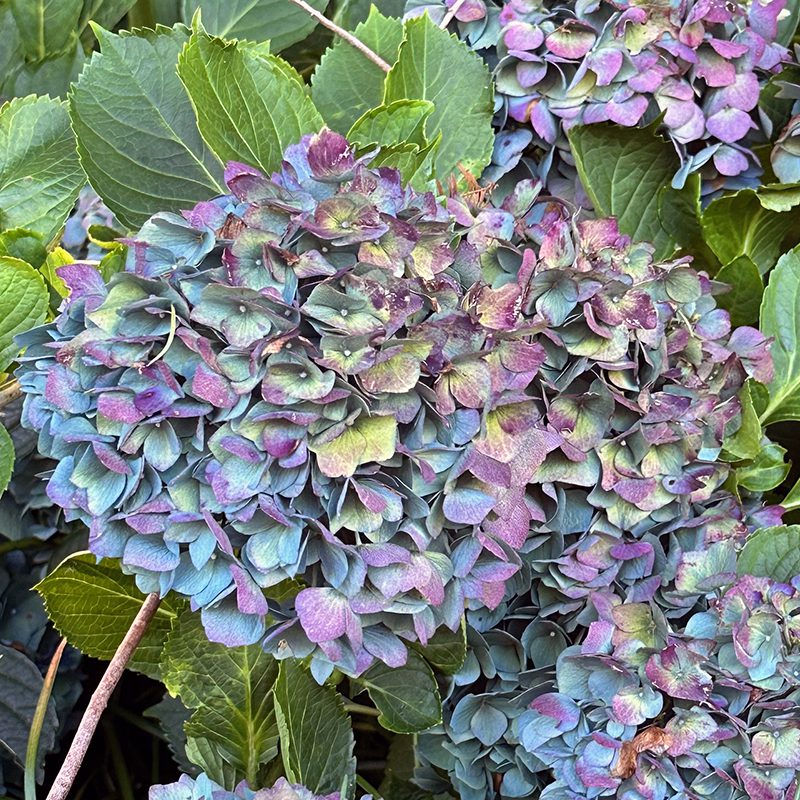
This is also the time of year when you can cut the blue or pink mopheads to dry them. If you’re cutting stems that are about 12″ long, take only four or five from each shrub, favoring the ones that are on stems closer to the ground. This won’t impact your 2025 flowers significantly.

15 Comments
Leave a Comment
Subscribe To Our Newsletter
Sign up for our weekly email about sales and events.
Mine are dying wilting leaves what do I need to do
Water them deeply.
I put a new plant in this summer,followed nursery instructions,but now it looks dead.Any instructions?I live in North Georgia.
Hydrangeas are very prone to drought damage. They need more frequent watering, but they also like well-drained soils. The best you can do now is to water your plant deeply once a week if your temperatures are below 60 at night, or twice a week if it’s still hot where you live. It’s best to use a sprinkler, so that the entire area is watered, not to hand water. Mulch around the plant helps to keep moisture in the soil. You’ll know next spring if it’s still alive or not.
In addition to frequent watering, they also need to be in a shady area as well as have a good barrier like mulch around the bottom to prevent the soil from drying out. Trust me. After fighting for over a year, I’ve finally nailed it I think.
What about the southern states? Should they be cut back,
The big-leaf (Hydrangea macrophylla) mopheads should never be cut back. They have their flower buds right now for next year.
I need to move mine to a shadier area, when do I do this?
Any time now – the earlier in the fall the better. If there isn’t regular rainfall, water it well once a week for as long as you can.
Live in south Florida brought a new baby plant home from Ohio this summer in a pot. It’s doing well but is there any special treatment I should do over the Florida winter?
There are many species of Hydrangeas and without knowing which you have it’s impossible to advise you. For Florida, winter temperatures aren’t a problem but the summer heat will be. Good luck!
I live in mid-coastal Maine. Last year I was gifted a beautiful purple hydrangea for Mother’s Day. I planted it where it received full sunlight. Into the summer months, it was being burned by the sun so I moved it to where it gets morning sun only. The plant looks healthy but did not produce any blooms this year. Should I move it to another location with more sun? Is this the time of year to move it?
The gift Hydrangeas may not be bud-hardy enough for Maine. These plants make their flower buds in July and August for the following year, and flowering depends on those buds not getting zapped by winter temperatures. They are often root-hardy but not bud-hardy. More sun isn’t the issue. If your winter temps commonly fall below 15 degrees for a length of time, that is enough to kill off flowers. And no, protecting them doesn’t help.
I am trying to maintain my deceased mother’s garden, and we have a Hydrangea (started white, then pink, now they’re almost deep red. I think she called it strawberries and cream?) that has overtaken a flower bed and needs to be moved. Is it OK to move it now? Can I divide it?
Yes to moving but not dividing. This is a Hydrangea paniculata, which isn’t as successfully divided as some of the other varieties of Hydrangeas. Move soon, then prune in the spring once it breaks dormancy.