
Notable Natives: Major Wheeler Honeysuckle
Notable Natives: Major Wheeler Honeysuckle
When it comes to perennial vines, one of the most pleasing is honeysuckle, but it’s important to know that there are varieties that are native to the eastern United States, and others that are invasive species from Asia, such as Lonicera japonica. Our native plant, Lonicera sempervirens is both beautiful and desirable for reasons other than its indigenous status. Here’s why you might want to put this vine in your yard or garden.
Long period of blooming.
The most popular variety of Lonicera sempervirens is ‘Major Wheeler.’ It has brilliant coral-colored flowers that appear in late-May and continue through July. In the right situation (full sun and a deep once-a-week watering) this honeysuckle is in flower for most of the summer.
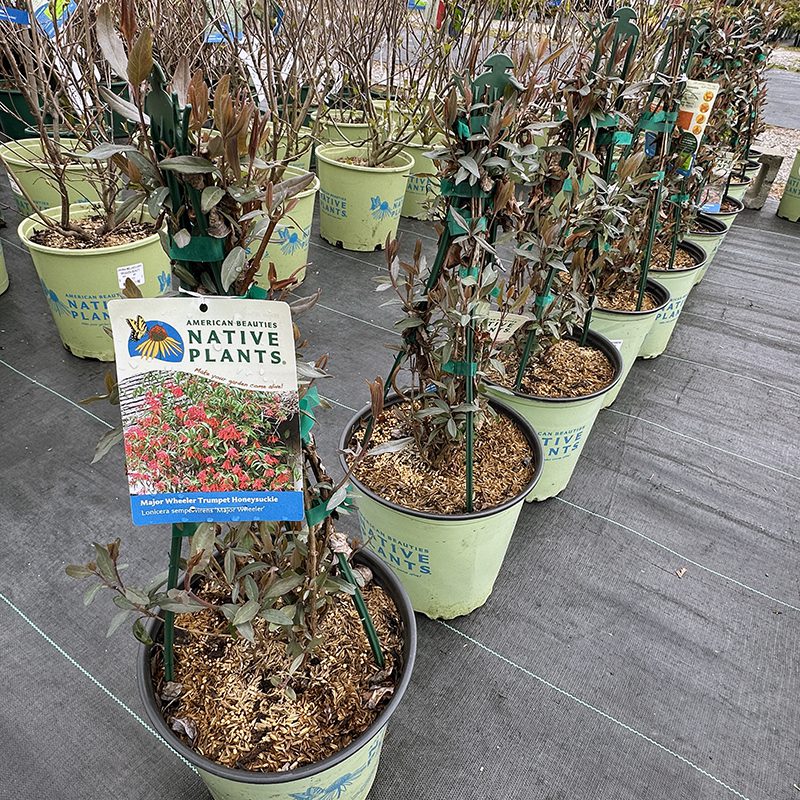
Plant it in full sun or part-sun.
‘Major Wheeler’ honeysuckle grows best in full sun, but as long as it is in a location where it gets at least four hours of sun in the middle of the day it will grow well.

Hummingbirds love Lonicera sempervirens.
If you love to watch the hummingbirds in action, you need this vine. Place it where you’re likely to see the birds come and go in the summer. Another advantage of this honeysuckle is that it flowers on new growth, so if you need to trim it back every spring you can do so without affecting flowering. This is an advantage for those who have smaller trellises or arbors. But ‘Major Wheeler’ can also grow to ornament a larger structure as well, so it’s adaptable to a variety of yards and gardens.

The vines aren’t too massive.
Some perennial vines are so large and heavy that they overtake and even destroy the structures they are planted on. This is not the case with Lonicera sempervirens. When planted on something smaller, such as a lamppost, simply prune it back every spring by cutting some of the stems in half and others down near the ground. The vine will regenerate new growth that year that doesn’t overwhelm the light post. On larger structures you can let the plant go, cutting off dead wood in the early spring when it breaks dormancy, or rejuvenating older plants by pruning down or removing a third of the stems.
In average soils this plant doesn’t need much fertilizer, although a top-dressing of compost every spring will keep the soil and plant healthy. (You can’t go wrong with a bag of Coast of Maine Lobster compost.) Water your new plants deeply once a week, watering the entire area around the plants, not just the base of the vine itself: plants won’t grow a strong root system if the soil around the stem is too dry.
1 Comment
Leave a Comment
Subscribe To Our Newsletter
Sign up for our weekly email about sales and events.
I have a Wheeler honeysuckle vine, newly planted in the spring. It was approximately 6 inches tall when it arrived and it is now well over 5 ft tall, but has not bloomed. It is planted in a pot in Missouri. It is now late July with no blooms, what am I doing wrong?