
Notable Natives: American Holly
Notable Natives: American Holly
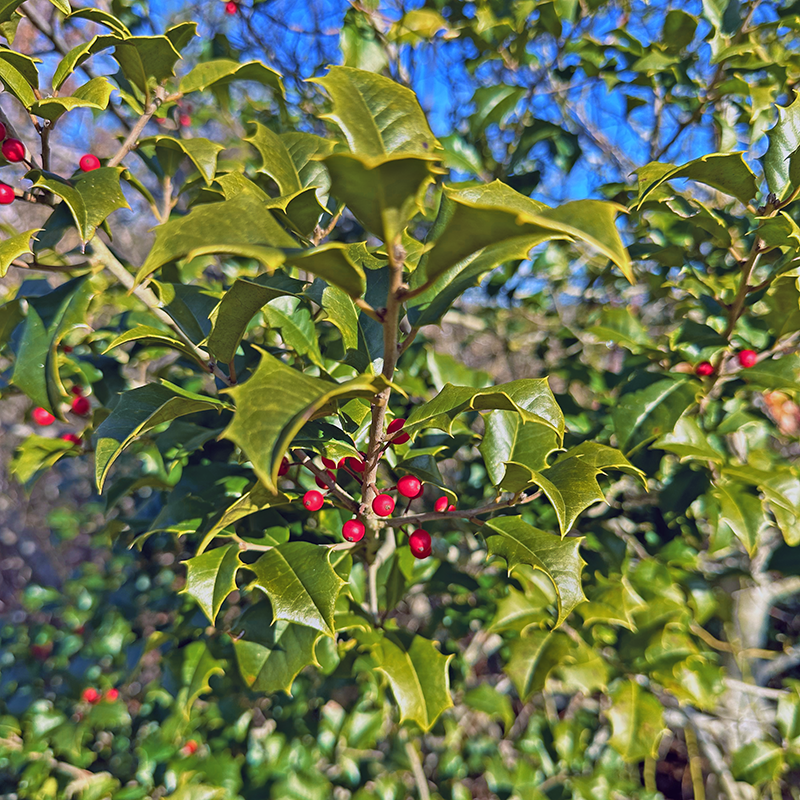
In the winter when many of our plants don’t have their foliage and the landscape often looks brown and white, our native holly, Ilex opaca, comes to the rescue. This broadleaf evergreen tree belongs in most Cape Cod landscapes. Why? Because it delivers so much.
Fruit for the Birds
The berries on American holly are a huge source of food for the birds. Robins, cedar waxwings, bluebirds, cardinals and flickers are just a few of the birds that eat Ilex opaca berries. While in many parts of the country robins are viewed as a spring bird, here on the Cape they are winter time visitors, down from Canada, and our holly berries sustain them.

Beautiful Bark
Although American holly gets the most attention for its berries and evergreen foliage, the trunks of this tree are a major feature for this plant. Smooth, pale and often mottled in shades of silver and tan, their trunks can also be graced by the subtle colors of lichen as the plants grow older.

Sun or Part-Shade
Ilex opaca grows well in sun or part-shade. In very shady locations it will live, but the foliage might not be as thick as when the plants receive more sun.
Where to Plant American Holly
American holly is a great tree to plant in groups of three, five or more. In wild areas these frequently grow in groves and since they are not huge, heavy plants they can grow in groups very successfully. Plant them where they can grow to be 15 to 25 feet tall, and as they mature, limb them up (remove lower branches) to expose the bottom four or five feet of their trunks.
This native plant is perfect to include in mixed-evergreen privacy borders, not only because it grows tall enough to screen nearby houses and properties, but because the leaves contrast nicely with other screening plants. Use Ilex opaca in groups of three, planted four feet apart in triangles, next to Green Giant arborvitae (Thuja (standishii x plicata) ‘Green Giant’), Japanese cedar (Cryptomeria japonica), weeping Alaska cedar (Chamaecyparis nootkatensis ‘Pendula’), for a natural looking and beautiful privacy screen.
Since American holly grows tall and in a tree-form, this isn’t a plant to place in a foundation planting. It does make a lovely specimen tree, however, and can be placed where it will be admired out windows.

How to Grow American Holly
Plant these native trees in normal Cape Cod soil…they love good drainage and acidic growing conditions. The only place where this Ilex won’t thrive is in heavy, consistently wet locations. Water newly planted American holly trees deeply once a week for the first year or two when they are getting established, but after that they are very drought tolerant and are suited to growing in places without regular irrigation.
Things to be Aware of…
Ilex opaca drops its oldest leaves in the late spring or early summer when the new foliage begins to grow. This is a natural process and there is nothing wrong with the plants. Those leaves are prickly, however, so don’t place this tree near a garden where you are tending to other plants on an on-going basis. Rather, this is the perfect tree to use where you have low-growing plants that are naturally mulched by the fallen holly leaves. Geranium macrorrhizum, Epimedium, or one of the native sedges such as Carex pennsylvanica are good perennial ground covers around American holly.
All hollies can occasionally get scale, an insect that can be seen under the leaves and along stems. Often the first sign that your holly has scale is a charcoal-black coating on the tops of the leaves. This is sooty mold, and it grows on the plant sap that the scale excretes. Treat holly scale with all seasons oil (aka horticultural oil) sprayed under the foliage three or four times per year.
American holly can also show signs of holly leaf miner, which causes tan to gray lines in foliage as the larvae tunnel inside of the leaves. Usually this isn’t a significant problem, and most people ignore it. You can read a fact sheet about leaf miner from the University of Massachusetts Extension here.

Subscribe To Our Newsletter
Sign up for our weekly email about sales and events.