
Why I Feed The Birds
Why I Feed The Birds
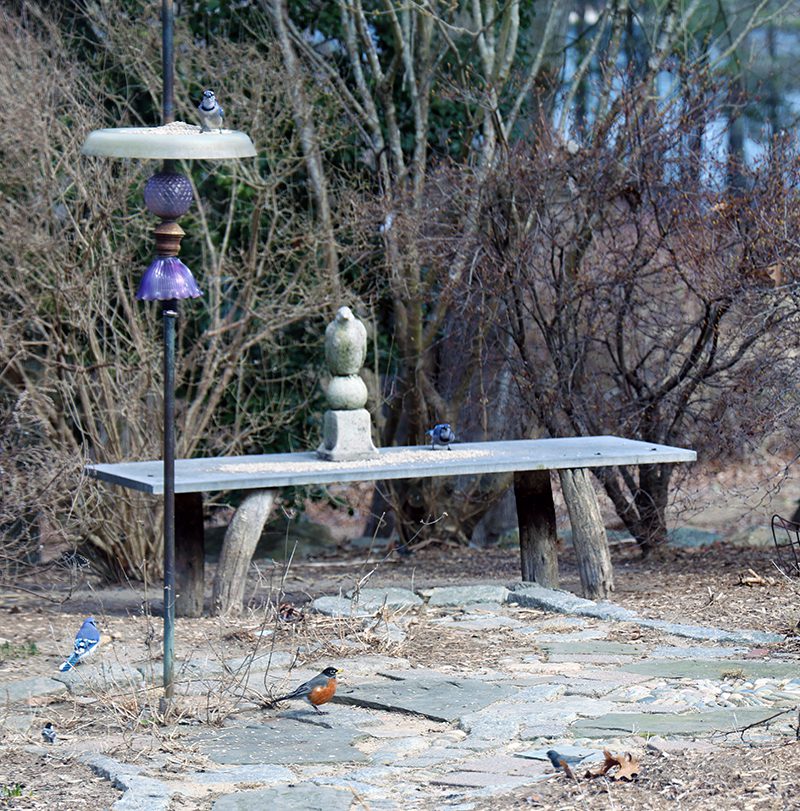
Every winter we have flocks of robins that I imagine have come down from Canada to spend the cold season on Cape Cod. They eat the berries on our native holly (Ilex opaca), Eastern red cedars (Juniperus virginiana) and greenbrier (Smilax roundifolia). Then they gather around my heated birdbaths like college students on spring break at the resort hot tub. When the robins are around I often have to change the water in the birdbath several times a day. The pleasure that I get from watching the action – robins and other birds – around the birdbath repays me severalfold for my efforts.

Feeding the birds and providing open water during the coldest time of year makes my yard a kaleidoscope of motion and color all winter. When my garden is mostly dormant, the birds provide endless change in the landscape. I never know what I will see when I glance out my windows at the feeders and birdbath.

Watching bird behavior at a feeder gives me a small window into the natural world. I have seen how different birds tend to come at different times. In the morning there will large groups of bluejays and cardinals, followed by the morning doves, and the smaller birds. I see how “the big beak rules” at the feeder, as other birds scatter when the woodpeckers arrive. And I take particular delight in the late afternoon when it’s what I have come to call The Cardinal Hour. These red birds, normally territorial, put their turf wars aside just before sunset when they are the last group to come to feeder. Often I will have twenty cardinals moving between the feeders, ground, and the surrounding shrubs.

We have chosen to keep our bird feeding simple. We only feed black oil sunflower seed, and choose the mix that is mostly shelled since all birds eat it and there is less shell waste on our patio. We only put out what we have seen that the birds can finish in a day so we’re less likely to attract rodents.

This winter there has been a resident robin who stays under our feeders all day. He doesn’t flock with the others of his species, but pokes around eating sunflower chips and whatever he roots for in the surrounding gardens. I affectionately call him Fat Boy, because he’s a most rotund robin. It will be interesting to see if he heads north with the rest in the spring, or if he’s decided to make my garden his permanent residence.
Those who want to explore more about bird behavior at feeders should read this article from The Cornell Lab of Ornithology. The Cornell Lab’s website is a wonderful source of information about the birds. If you’re new to feeding the birds, go to their website for advice about feeders, how to attract specific birds, and feeder sanitation. They are also the developer of the Merlin bird ID app for smart phones. If you haven’t tried this app, or feeding the birds, this might be just the end-of-winter diversion you’ve been looking for. Enjoy!
1 Comment
Leave a Comment
Subscribe To Our Newsletter
Sign up for our weekly email about sales and events.
I love feeding the birds! I have 4 shepherds hooks right in front of my big living room window. My cats get a front row seat just as we do. I supply my birds with a variety of black sunflower, safflower, peanuts, thistle and suet.
The woodpecker that lives and raises his family in my oak tree love the suet and peanuts, the robins love the black sunflower seeds, the chickadees love the safflower, the tit mouse love the safflower. I chase the crows away since they are bullies who refuse to share.